
Guy Savage
来自 Metal Gear Wiki
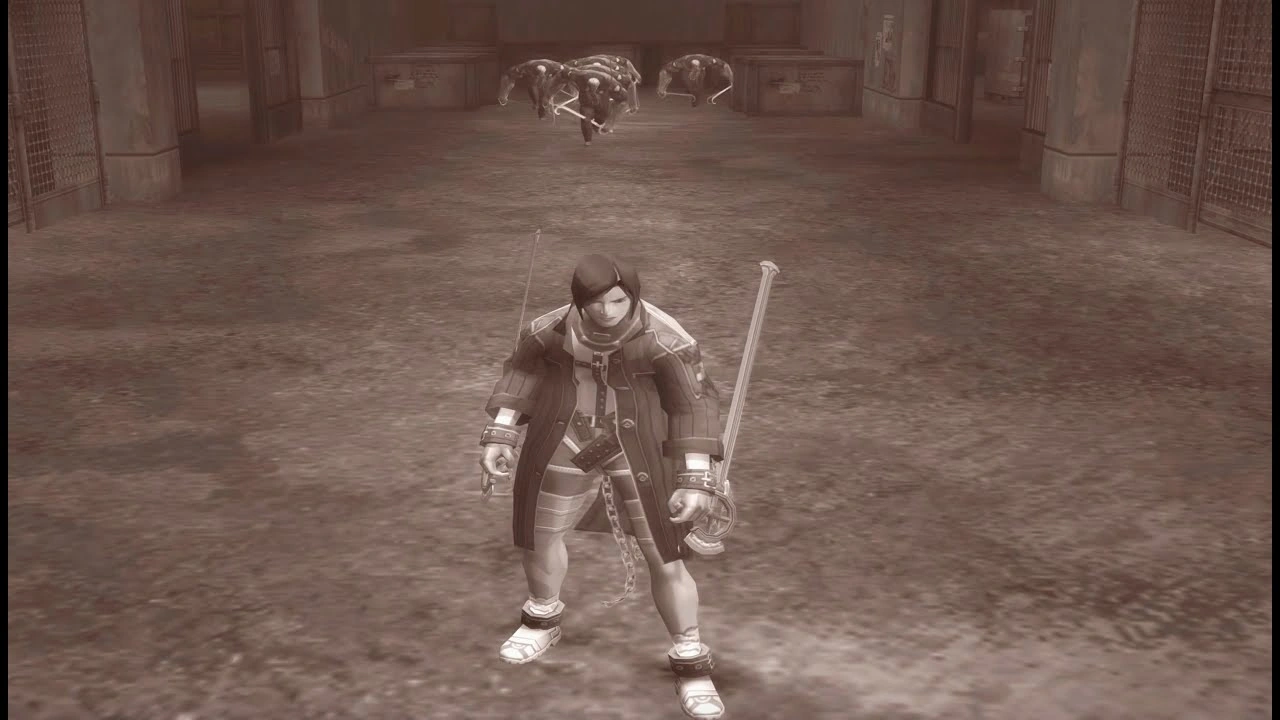

The Guy Savage Mini-Game.
"Guy Savage" is the name of the nightmare sequence in the PlayStation 2 versions of Metal GearSolid 3. The minigame was written and directed by Shuyo Murata. The game is a basic hack-and-slash affair where the player encounters a vast amount of enemies, and must press the attack buttons repeatedly to defeat them.
Guy Savage returns in the remake and can be played as a standalone mini game after completing the main game.
Witnessing the dream
When Naked Snake is placed in the jail cell in Groznyj Grad immediately after being tortured by Colonel Volgin, the player must save their game before escaping from the cell. When that save is loaded, the player will be in Snake's dream.
During his conversation with Para-Medic while saving, Para-Medic will talk about the movie Dracula as Snake starts to fall asleep, much to his chagrin, as he is secretly afraid of vampires. After waking up from the dream, Snake chastises Para-Medic for giving him nightmares about vampires.
A "Dream" save can be distinguished from a normal save on the memory card: the flower in front of the gun is normally white, but in a "Dream" save, it is red. If the player saves over the "Dream" save (either by progressing in the game after escaping from the cell, or by overwriting the save with another save), the flower on the save file will again be white. In the remake, the “Dream” save of the Save interface is preceded by red to distinguish it from a regular save.
Overview
Snake's dream consists of a large warehouse with destructible walls, zombie-like characters wearing police uniforms, and a player-controlled character holding two hook-swords. The zombies, who also each wield two hook-swords, will always be chasing after the player.
The player can do a variety of attacks. For example, pressing  will make the player spin around with the two swords sticking out, while pressing
 will allow them to jump where they can press
 to do a downward slash; the player can also perform a dash with the R2 button with the option to kick at the end of the dash with the button. At certain points during the dream, the character will suddenly undergo a transformation where he turns into a monster himself. In this feral state, the character's strength is amplified and he performs more brutal attacks on his enemies. The player seems to have to kill a certain number of enemies in a certain amount of time in order to transform. This is characterized by a change in hair color from black to white and eventually to brown, where he then becomes a monster. The game will last for roughly five minutes. In the remake, this strength has been changed to a blue light all over the player.
There is no objective other than killing the zombies. The zombies will always respawn, resulting in the dream never ending until the player kills a certain amount of zombies or time runs out and Snake wakes up. In the remake, there is a new boss-level enemy dressed like a mage who will summon zombies to attack players. After the player has killed a certain number of zombies, the game will end with a cut scene where Naked Snake wakes up in his jail cell.
In Delta's re-imagining of the minigame, the game consists of a graveyard with a central hill, broken iron fences, and headstones adorning the environment, the zombified enemies are more like skeletons or Draugr, and overall, Delta generally represents the idea of a nightmare about "Dracula" better. The attack button (LMB on PC) unleashes a basic combo of sword attacks, finished with a flurry of stabs that lasts longer the more you tap the button, while the secondary/aim button on PC (RMB) triggers a lunging attack that targets the nearest enemy to your movement point, while dodging works the same as the base game (the roll button, SPACE on PC), The ALT attack also does effect your combo slightly.
After defeating an amount of enemies, a cutscene will play, depicting "Dracula" rising from a grave on the top of the hill and he will surround himself with enemies. Defeating him and enough of his "soldiers" will trigger the cutscene where Snake wakes up.
Inclusion in Metal Gear Solid 3
It is unknown why the game was included in Metal Gear Solid 3 other than as an Easter egg for players to find. When Hideo Kojima was asked why it was included in Metal Gear Solid 3, he simply responded with "what game?" In a later interview, he stated that the dream was originally going to feature Gradius, another classic Konami game, but decided that he would rather include an original game. He later reiterated this in a tweet.[1] Guy Savage was originally meant to be developed later on into a full standalone game, but the project was ultimately cancelled.[2] A discussion during the 2011 and 2012 coverage for the Zone of the Enders: HD Collection indicated that Guy Savage had been derived from a canceled prototype for Zone of the Enders 3, also known during development as "Anubis 2", with hints of this connection also being found in the in-game code.[3]
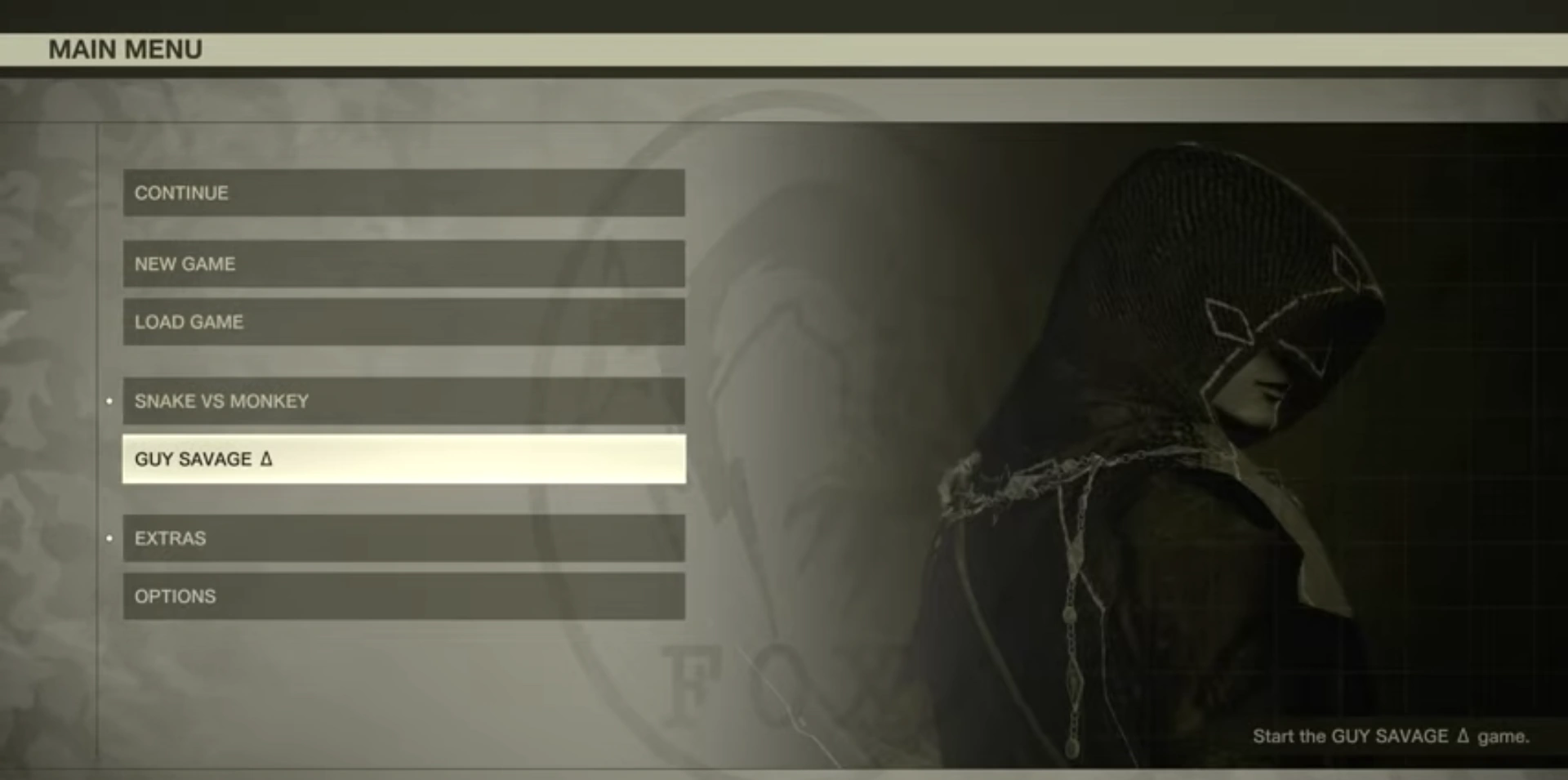

The Guy Savage Delta Mini-Game's Menu Option.
The scene featuring Snake waking up from the nightmare was included in some early trailers for Metal Gear Solid 3, albeit framed in such a way that indicated he woke up from a nightmare relating to The Boss torturing him.
Guy Savage returns in Metal Gear Solid Delta: Snake Eater and can be played as a standalone mini game. It is larger than the original version and takes place in a cemetery instead of an abandoned building. The game ends either when the player is killed or manages to defeat all the enemies until the screen fades out like the original. When you save at the correct point to access the mini-game, it will also have a red tag, reminding you to not save over it if you want to replay it.
External links
- YouTube video of Guy Savage
- Guy Savage in full color